Draw Mohrs Circle for This State of Stress
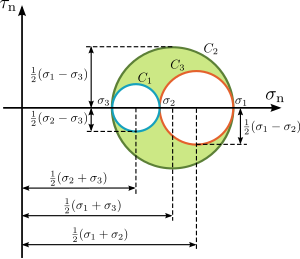
Effigy ane. Mohr's circles for a 3-dimensional country of stress
Mohr'due south circle is a two-dimensional graphical representation of the transformation law for the Cauchy stress tensor.
Mohr'south circle is often used in calculations relating to mechanical engineering science for materials' strength, geotechnical applied science for strength of soils, and structural engineering for strength of congenital structures. Information technology is also used for computing stresses in many planes by reducing them to vertical and horizontal components. These are chosen principal planes in which main stresses are calculated; Mohr's circle tin likewise be used to find the principal planes and the principal stresses in a graphical representation, and is one of the easiest ways to practice so.[one]
Subsequently performing a stress analysis on a material body assumed as a continuum, the components of the Cauchy stress tensor at a particular textile point are known with respect to a coordinate arrangement. The Mohr circle is so used to determine graphically the stress components acting on a rotated coordinate system, i.due east., acting on a differently oriented airplane passing through that signal.
The abscissa and ordinate ( , ) of each signal on the circle are the magnitudes of the normal stress and shear stress components, respectively, acting on the rotated coordinate system. In other words, the circle is the locus of points that represent the state of stress on private planes at all their orientations, where the axes represent the primary axes of the stress chemical element.


19th-century German engineer Karl Culmann was the starting time to excogitate a graphical representation for stresses while considering longitudinal and vertical stresses in horizontal beams during bending. His piece of work inspired fellow German language engineer Christian Otto Mohr (the circle'due south namesake), who extended information technology to both two- and three-dimensional stresses and developed a failure criterion based on the stress circle.[2]
Alternative graphical methods for the representation of the stress country at a signal include the Lamé'due south stress ellipsoid and Cauchy'south stress quadric.
The Mohr circle tin can be practical to any symmetric 2x2 tensor matrix, including the strain and moment of inertia tensors.
Motivation [edit]

Effigy two. Stress in a loaded deformable material body causeless as a continuum.
Internal forces are produced betwixt the particles of a deformable object, assumed as a continuum, as a reaction to applied external forces, i.due east., either surface forces or body forces. This reaction follows from Euler's laws of motion for a continuum, which are equivalent to Newton's laws of motion for a particle. A measure of the intensity of these internal forces is called stress. Because the object is assumed as a continuum, these internal forces are distributed continuously within the volume of the object.
In engineering science, east.g., structural, mechanical, or geotechnical, the stress distribution within an object, for instance stresses in a rock mass effectually a tunnel, airplane wings, or building columns, is determined through a stress analysis. Calculating the stress distribution implies the decision of stresses at every bespeak (textile particle) in the object. Co-ordinate to Cauchy, the stress at any point in an object (Figure 2), causeless equally a continuum, is completely defined by the nine stress components of a second order tensor of type (2,0) known as the Cauchy stress tensor, :


![{\boldsymbol {\sigma }}=\left[{{\begin{matrix}\sigma _{{11}}&\sigma _{{12}}&\sigma _{{13}}\\\sigma _{{21}}&\sigma _{{22}}&\sigma _{{23}}\\\sigma _{{31}}&\sigma _{{32}}&\sigma _{{33}}\\\end{matrix}}}\right]\equiv \left[{{\begin{matrix}\sigma _{{xx}}&\sigma _{{xy}}&\sigma _{{xz}}\\\sigma _{{yx}}&\sigma _{{yy}}&\sigma _{{yz}}\\\sigma _{{zx}}&\sigma _{{zy}}&\sigma _{{zz}}\\\end{matrix}}}\right]\equiv \left[{{\begin{matrix}\sigma _{x}&\tau _{{xy}}&\tau _{{xz}}\\\tau _{{yx}}&\sigma _{y}&\tau _{{yz}}\\\tau _{{zx}}&\tau _{{zy}}&\sigma _{z}\\\end{matrix}}}\right]](https://wikimedia.org/api/rest_v1/media/math/render/svg/150f0bb6d0473b0cc572e736e3f0c61ae490cf0e)

Figure 3. Stress transformation at a bespeak in a continuum nether plane stress conditions.
After the stress distribution within the object has been determined with respect to a coordinate system , it may be necessary to summate the components of the stress tensor at a detail material point with respect to a rotated coordinate system , i.eastward., the stresses acting on a plane with a different orientation passing through that point of involvement —forming an bending with the coordinate system (Figure three). For instance, it is of involvement to find the maximum normal stress and maximum shear stress, every bit well as the orientation of the planes where they deed upon. To achieve this, it is necessary to perform a tensor transformation under a rotation of the coordinate system. From the definition of tensor, the Cauchy stress tensor obeys the tensor transformation police force. A graphical representation of this transformation law for the Cauchy stress tensor is the Mohr circle for stress.


Mohr's circle for ii-dimensional state of stress [edit]

Figure 4. Stress components at a plane passing through a point in a continuum under plane stress weather.
In two dimensions, the stress tensor at a given textile bespeak with respect to any two perpendicular directions is completely defined past just three stress components. For the particular coordinate system these stress components are: the normal stresses and , and the shear stress . From the balance of angular momentum, the symmetry of the Cauchy stress tensor can exist demonstrated. This symmetry implies that . Thus, the Cauchy stress tensor can be written every bit:


![{\boldsymbol {\sigma }}=\left[{{\begin{matrix}\sigma _{x}&\tau _{{xy}}&0\\\tau _{{xy}}&\sigma _{y}&0\\0&0&0\\\end{matrix}}}\right]\equiv \left[{{\begin{matrix}\sigma _{x}&\tau _{{xy}}\\\tau _{{xy}}&\sigma _{y}\\\end{matrix}}}\right]](https://wikimedia.org/api/rest_v1/media/math/render/svg/946034030fac5e3d547e35f94ac672ed9dbc87d2)
The objective is to employ the Mohr circumvolve to find the stress components and on a rotated coordinate system , i.e., on a differently oriented airplane passing through and perpendicular to the - airplane (Figure 4). The rotated coordinate system makes an angle with the original coordinate system .


Equation of the Mohr circle [edit]
To derive the equation of the Mohr circle for the two-dimensional cases of plane stress and plane strain, first consider a two-dimensional infinitesimal material element around a material point (Figure 4), with a unit area in the direction parallel to the - aeroplane, i.e., perpendicular to the page or screen.

From equilibrium of forces on the minute chemical element, the magnitudes of the normal stress and the shear stress are given by:


-
Derivation of Mohr's circle parametric equations - Equilibrium of forces From equilibrium of forces in the direction of ( -axis) (Figure four), and knowing that the expanse of the aeroplane where acts is , nosotros have: Even so, knowing that
we obtain
Now, from equilibrium of forces in the direction of ( -axis) (Figure 4), and knowing that the expanse of the plane where acts is , nosotros have:
However, knowing that
we obtain







Both equations tin can likewise be obtained by applying the tensor transformation law on the known Cauchy stress tensor, which is equivalent to performing the static equilibrium of forces in the management of and .
-
Derivation of Mohr's circle parametric equations - Tensor transformation The stress tensor transformation law can be stated equally Expanding the right mitt side, and knowing that and , we have:
Still, knowing that
we obtain
However, knowing that
we obtain
It is non necessary at this moment to summate the stress component interim on the plane perpendicular to the plane of activeness of equally it is non required for deriving the equation for the Mohr circle.
![{\begin{aligned}{\boldsymbol {\sigma }}'&={\mathbf A}{\boldsymbol {\sigma }}{\mathbf A}^{T}\\\left[{{\begin{matrix}\sigma _{{x'}}&\tau _{{x'y'}}\\\tau _{{y'x'}}&\sigma _{{y'}}\\\end{matrix}}}\right]&=\left[{{\begin{matrix}a_{{x}}&a_{{xy}}\\a_{{yx}}&a_{{y}}\\\end{matrix}}}\right]\left[{{\begin{matrix}\sigma _{{x}}&\tau _{{xy}}\\\tau _{{yx}}&\sigma _{{y}}\\\end{matrix}}}\right]\left[{{\begin{matrix}a_{{x}}&a_{{yx}}\\a_{{xy}}&a_{{y}}\\\end{matrix}}}\right]\\&=\left[{{\begin{matrix}\cos \theta &\sin \theta \\-\sin \theta &\cos \theta \\\end{matrix}}}\right]\left[{{\begin{matrix}\sigma _{{x}}&\tau _{{xy}}\\\tau _{{yx}}&\sigma _{{y}}\\\end{matrix}}}\right]\left[{{\begin{matrix}\cos \theta &-\sin \theta \\\sin \theta &\cos \theta \\\end{matrix}}}\right]\end{aligned}}](https://wikimedia.org/api/rest_v1/media/math/render/svg/c98aac6cba73c966e89d772397263f69ee507e4d)






These 2 equations are the parametric equations of the Mohr circumvolve. In these equations, is the parameter, and and are the coordinates. This means that by choosing a coordinate organization with abscissa and ordinate , giving values to the parameter volition place the points obtained lying on a circle.

Eliminating the parameter from these parametric equations will yield the not-parametric equation of the Mohr circumvolve. This tin be achieved by rearranging the equations for and , starting time transposing the kickoff term in the first equation and squaring both sides of each of the equations so adding them. Thus nosotros accept
![{\begin{aligned}\left[\sigma _{{\mathrm {n}}}-{\tfrac {1}{2}}(\sigma _{x}+\sigma _{y})\right]^{2}+\tau _{{\mathrm {n}}}^{2}&=\left[{\tfrac {1}{2}}(\sigma _{x}-\sigma _{y})\right]^{2}+\tau _{{xy}}^{2}\\(\sigma _{{\mathrm {n}}}-\sigma _{{\mathrm {avg}}})^{2}+\tau _{{\mathrm {n}}}^{2}&=R^{2}\end{aligned}}](https://wikimedia.org/api/rest_v1/media/math/render/svg/2774a663ddaa56d3418815d5a7d05fcf456d6f12)
where
![R={\sqrt {\left[{\tfrac {1}{2}}(\sigma _{x}-\sigma _{y})\right]^{2}+\tau _{{xy}}^{2}}}\quad {\text{and}}\quad \sigma _{{\mathrm {avg}}}={\tfrac {1}{2}}(\sigma _{x}+\sigma _{y})](https://wikimedia.org/api/rest_v1/media/math/render/svg/6a7f5d5e3408c2d465f9e463c5576810f83d2401)
This is the equation of a circumvolve (the Mohr circle) of the form

with radius centered at a point with coordinates in the coordinate organization.


Sign conventions [edit]
There are two separate sets of sign conventions that need to be considered when using the Mohr Circle: One sign convention for stress components in the "physical infinite", and some other for stress components in the "Mohr-Circle-space". In addition, within each of the two gear up of sign conventions, the engineering mechanics (structural technology and mechanical engineering) literature follows a different sign convention from the geomechanics literature. There is no standard sign convention, and the choice of a particular sign convention is influenced past convenience for adding and interpretation for the particular problem in hand. A more detailed caption of these sign conventions is presented below.
The previous derivation for the equation of the Mohr Circle using Effigy iv follows the technology mechanics sign convention. The technology mechanics sign convention will be used for this article.
Concrete-infinite sign convention [edit]
From the convention of the Cauchy stress tensor (Figure iii and Figure 4), the beginning subscript in the stress components denotes the face up on which the stress component acts, and the 2nd subscript indicates the direction of the stress component. Thus is the shear stress interim on the face with normal vector in the positive direction of the -axis, and in the positive direction of the -axis.
In the concrete-infinite sign convention, positive normal stresses are outward to the aeroplane of activeness (tension), and negative normal stresses are inward to the airplane of action (compression) (Figure v).
In the physical-space sign convention, positive shear stresses act on positive faces of the cloth chemical element in the positive direction of an centrality. Also, positive shear stresses act on negative faces of the cloth chemical element in the negative management of an centrality. A positive confront has its normal vector in the positive management of an centrality, and a negative face has its normal vector in the negative direction of an axis. For example, the shear stresses and are positive considering they act on positive faces, and they act too in the positive management of the -axis and the -axis, respectively (Figure 3). Similarly, the respective contrary shear stresses and acting in the negative faces have a negative sign because they act in the negative direction of the -axis and -axis, respectively.

Mohr-circle-space sign convention [edit]
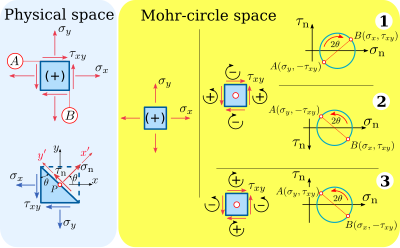
Figure v. Engineering mechanics sign convention for drawing the Mohr circle. This article follows sign-convention # 3, as shown.
In the Mohr-circle-space sign convention, normal stresses have the same sign as normal stresses in the concrete-space sign convention: positive normal stresses act outward to the plane of action, and negative normal stresses act inward to the plane of activeness.
Shear stresses, however, take a different convention in the Mohr-circumvolve infinite compared to the convention in the physical space. In the Mohr-circumvolve-infinite sign convention, positive shear stresses rotate the material element in the counterclockwise direction, and negative shear stresses rotate the fabric in the clockwise direction. This style, the shear stress component is positive in the Mohr-circle space, and the shear stress component is negative in the Mohr-circle space.
Ii options be for drawing the Mohr-circle space, which produce a mathematically right Mohr circumvolve:
- Positive shear stresses are plotted upwards (Figure five, sign convention #i)
- Positive shear stresses are plotted down, i.east., the -axis is inverted (Effigy v, sign convention #ii).
Plotting positive shear stresses upward makes the angle on the Mohr circle accept a positive rotation clockwise, which is reverse to the physical space convention. That is why some authors[3] prefer plotting positive shear stresses down, which makes the bending on the Mohr circle take a positive rotation counterclockwise, similar to the concrete infinite convention for shear stresses.
To overcome the "result" of having the shear stress axis downward in the Mohr-circumvolve space, there is an alternative sign convention where positive shear stresses are assumed to rotate the material element in the clockwise management and negative shear stresses are assumed to rotate the textile element in the counterclockwise direction (Effigy 5, pick 3). This way, positive shear stresses are plotted up in the Mohr-circle infinite and the angle has a positive rotation counterclockwise in the Mohr-circle space. This alternative sign convention produces a circle that is identical to the sign convention #2 in Figure 5 because a positive shear stress is likewise a counterclockwise shear stress, and both are plotted downward. Too, a negative shear stress is a clockwise shear stress, and both are plotted upward.
This commodity follows the engineering mechanics sign convention for the concrete space and the alternative sign convention for the Mohr-circumvolve space (sign convention #3 in Figure 5)
Drawing Mohr's circle [edit]

Assuming nosotros know the stress components , , and at a point in the object under study, as shown in Figure four, the following are the steps to construct the Mohr circle for the country of stresses at :
- Draw the Cartesian coordinate system with a horizontal -axis and a vertical -axis.
- Plot ii points and in the space corresponding to the known stress components on both perpendicular planes and , respectively (Figure iv and 6), following the chosen sign convention.
- Draw the diameter of the circumvolve by joining points and with a straight line .
- Draw the Mohr Circle. The centre of the circle is the midpoint of the diameter line , which corresponds to the intersection of this line with the axis.


Finding main normal stresses [edit]

Stress components on a 2D rotating chemical element. Example of how stress components vary on the faces (edges) of a rectangular chemical element as the angle of its orientation is varied. Principal stresses occur when the shear stresses simultaneously disappear from all faces. The orientation at which this occurs gives the principal directions. In this instance, when the rectangle is horizontal, the stresses are given by The corresponding Mohr'due south circle representation is shown at the bottom.
![{\displaystyle \left[{\begin{matrix}\sigma _{xx}&\tau _{xy}\\\tau _{yx}&\sigma _{yy}\end{matrix}}\right]=\left[{\begin{matrix}-10&10\\10&15\end{matrix}}\right].}](https://wikimedia.org/api/rest_v1/media/math/render/svg/0689a21c2f433bcf6e3a8c6f90fa20df9695ccec)
The magnitude of the main stresses are the abscissas of the points and (Effigy vi) where the circumvolve intersects the -centrality. The magnitude of the major principal stress is always the greatest absolute value of the abscissa of any of these two points. Besides, the magnitude of the minor principal stress is ever the lowest absolute value of the abscissa of these 2 points. As expected, the ordinates of these two points are zero, corresponding to the magnitude of the shear stress components on the principal planes. Alternatively, the values of the principal stresses tin be found by




where the magnitude of the average normal stress is the abscissa of the centre , given by


and the length of the radius of the circle (based on the equation of a circle passing through 2 points), is given by

![R={\sqrt {\left[{\tfrac {1}{2}}(\sigma _{x}-\sigma _{y})\right]^{2}+\tau _{{xy}}^{2}}}](https://wikimedia.org/api/rest_v1/media/math/render/svg/cb62b3753948e2c8cbcc4b054de4f34d9630d711)
Finding maximum and minimum shear stresses [edit]
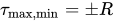
The maximum and minimum shear stresses correspond to the ordinates of the highest and lowest points on the circumvolve, respectively. These points are located at the intersection of the circumvolve with the vertical line passing through the eye of the circle, . Thus, the magnitude of the maximum and minimum shear stresses are equal to the value of the circumvolve's radius
Finding stress components on an capricious airplane [edit]
As mentioned before, after the two-dimensional stress analysis has been performed we know the stress components , , and at a cloth bespeak . These stress components human action in ii perpendicular planes and passing through as shown in Figure 5 and six. The Mohr circle is used to observe the stress components and , i.e., coordinates of any point on the circle, acting on whatsoever other plane passing through making an angle with the airplane . For this, two approaches can exist used: the double angle, and the Pole or origin of planes.

Double bending [edit]
As shown in Figure 6, to decide the stress components interim on a plane at an angle counterclockwise to the aeroplane on which acts, we travel an angle in the same counterclockwise direction effectually the circle from the known stress point to point , i.e., an angle between lines and in the Mohr circumvolve.


The double angle approach relies on the fact that the bending between the normal vectors to whatever ii physical planes passing through (Figure 4) is half the bending betwixt two lines joining their respective stress points on the Mohr circle and the center of the circle.
This double bending relation comes from the fact that the parametric equations for the Mohr circle are a office of . It tin can also exist seen that the planes and in the cloth chemical element around of Figure 5 are separated by an angle , which in the Mohr circle is represented past a angle (double the bending).


Pole or origin of planes [edit]

Figure seven. Mohr's circle for plane stress and airplane strain conditions (Pole arroyo). Any straight line drawn from the pole volition intersect the Mohr circle at a point that represents the state of stress on a plane inclined at the same orientation (parallel) in infinite equally that line.
The second arroyo involves the determination of a betoken on the Mohr circumvolve chosen the pole or the origin of planes. Any directly line drawn from the pole volition intersect the Mohr circle at a point that represents the country of stress on a airplane inclined at the aforementioned orientation (parallel) in space every bit that line. Therefore, knowing the stress components and on any particular plane, one can describe a line parallel to that plane through the particular coordinates and on the Mohr circle and find the pole as the intersection of such line with the Mohr circle. Equally an example, let'south presume we have a country of stress with stress components , , and , as shown on Figure 7. First, we tin depict a line from point parallel to the aeroplane of action of , or, if we choose otherwise, a line from indicate parallel to the plane of action of . The intersection of whatsoever of these 2 lines with the Mohr circle is the pole. One time the pole has been determined, to observe the country of stress on a plane making an bending with the vertical, or in other words a plane having its normal vector forming an angle with the horizontal airplane, then we can describe a line from the pole parallel to that airplane (See Effigy vii). The normal and shear stresses on that aeroplane are then the coordinates of the point of intersection between the line and the Mohr circle.


Finding the orientation of the principal planes [edit]
The orientation of the planes where the maximum and minimum chief stresses act, also known as chief planes, can be determined by measuring in the Mohr circumvolve the angles ∠BOC and ∠BOE, respectively, and taking half of each of those angles. Thus, the angle ∠BOC between and is double the angle which the major principal plane makes with aeroplane .


Angles and tin also be establish from the post-obit equation


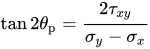
This equation defines ii values for which are apart (Effigy). This equation tin can exist derived straight from the geometry of the circle, or by making the parametric equation of the circle for equal to zero (the shear stress in the principal planes is always zero).


Example [edit]


Assume a material element under a state of stress every bit shown in Effigy eight and Figure 9, with the plane of one of its sides oriented x° with respect to the horizontal airplane. Using the Mohr circumvolve, find:
- The orientation of their planes of action.
- The maximum shear stresses and orientation of their planes of action.
- The stress components on a horizontal plane.
Check the answers using the stress transformation formulas or the stress transformation law.
Solution: Following the technology mechanics sign convention for the concrete infinite (Figure 5), the stress components for the material element in this case are:

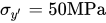
- .
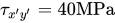
Following the steps for drawing the Mohr circle for this detail country of stress, nosotros first depict a Cartesian coordinate system with the -axis upward.
We and so plot two points A(50,xl) and B(-ten,-40), representing the state of stress at plane A and B as show in both Figure 8 and Figure ix. These points follow the applied science mechanics sign convention for the Mohr-circumvolve space (Effigy 5), which assumes positive normals stresses outward from the material element, and positive shear stresses on each aeroplane rotating the material element clockwise. This way, the shear stress acting on plane B is negative and the shear stress interim on airplane A is positive. The diameter of the circle is the line joining point A and B. The heart of the circle is the intersection of this line with the -centrality. Knowing both the location of the centre and length of the diameter, we are able to plot the Mohr circumvolve for this item state of stress.
The abscissas of both points E and C (Figure 8 and Figure ix) intersecting the -axis are the magnitudes of the minimum and maximum normal stresses, respectively; the ordinates of both points Due east and C are the magnitudes of the shear stresses interim on both the modest and major principal planes, respectively, which is zero for principal planes.
Even though the thought for using the Mohr circle is to graphically find unlike stress components by actually measuring the coordinates for unlike points on the circle, it is more convenient to ostend the results analytically. Thus, the radius and the abscissa of the middle of the circumvolve are
![{\begin{aligned}R&={\sqrt {\left[{\tfrac {1}{2}}(\sigma _{x}-\sigma _{y})\right]^{2}+\tau _{{xy}}^{2}}}\\&={\sqrt {\left[{\tfrac {1}{2}}(-10-50)\right]^{2}+40^{2}}}\\&=50{\textrm {MPa}}\\\end{aligned}}](https://wikimedia.org/api/rest_v1/media/math/render/svg/4f970da4c989f682a80bda6bb2ceb4285812314d)
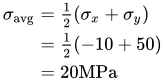
and the principal stresses are
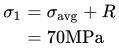
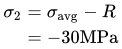
The coordinates for both points H and Yard (Effigy 8 and Figure nine) are the magnitudes of the minimum and maximum shear stresses, respectively; the abscissas for both points H and G are the magnitudes for the normal stresses acting on the same planes where the minimum and maximum shear stresses act, respectively. The magnitudes of the minimum and maximum shear stresses can be found analytically by

and the normal stresses acting on the same planes where the minimum and maximum shear stresses act are equal to

We tin choose to either use the double angle arroyo (Effigy 8) or the Pole approach (Figure 9) to find the orientation of the principal normal stresses and principal shear stresses.
Using the double bending approach we measure the angles ∠BOC and ∠BOE in the Mohr Circle (Figure 8) to find double the bending the major chief stress and the minor chief stress make with plane B in the physical space. To obtain a more than accurate value for these angles, instead of manually measuring the angles, we can utilize the analytical expression

One solution is: . From inspection of Figure 8, this value corresponds to the angle ∠BOE. Thus, the small-scale primary bending is
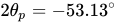

Then, the major chief angle is

Recall that in this particular example and are angles with respect to the aeroplane of action of (oriented in the -axis)and not angles with respect to the plane of action of (oriented in the -axis).
Using the Pole arroyo, nosotros first localize the Pole or origin of planes. For this, we depict through point A on the Mohr circumvolve a line inclined 10° with the horizontal, or, in other words, a line parallel to plane A where acts. The Pole is where this line intersects the Mohr circle (Effigy 9). To ostend the location of the Pole, we could describe a line through betoken B on the Mohr circumvolve parallel to the plane B where acts. This line would also intersect the Mohr circumvolve at the Pole (Figure 9).
From the Pole, we describe lines to different points on the Mohr circle. The coordinates of the points where these lines intersect the Mohr circumvolve indicate the stress components acting on a plane in the concrete infinite having the aforementioned inclination as the line. For instance, the line from the Pole to point C in the circle has the same inclination every bit the airplane in the concrete space where acts. This plane makes an angle of 63.435° with plane B, both in the Mohr-circle infinite and in the physical space. In the same way, lines are traced from the Pole to points E, D, F, One thousand and H to find the stress components on planes with the same orientation.
Mohr's circumvolve for a full general three-dimensional state of stresses [edit]

Effigy 10. Mohr's circle for a three-dimensional state of stress
To construct the Mohr circle for a general iii-dimensional case of stresses at a point, the values of the principal stresses and their master directions must be first evaluated.


Considering the principal axes as the coordinate organisation, instead of the general , , coordinate arrangement, and assuming that , then the normal and shear components of the stress vector , for a given airplane with unit vector , satisfy the following equations


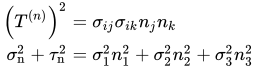

Knowing that , we tin can solve for , , , using the Gauss elimination method which yields



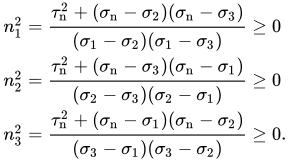
Since , and is non-negative, the numerators from these equations satisfy

- as the denominator and
- as the denominator and
- as the denominator and








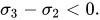
These expressions can be rewritten as
![{\begin{aligned}\tau _{{\mathrm {n}}}^{2}+\left[\sigma _{{\mathrm {n}}}-{\tfrac {1}{2}}(\sigma _{2}+\sigma _{3})\right]^{2}\geq \left({\tfrac {1}{2}}(\sigma _{2}-\sigma _{3})\right)^{2}\\\tau _{{\mathrm {n}}}^{2}+\left[\sigma _{{\mathrm {n}}}-{\tfrac {1}{2}}(\sigma _{1}+\sigma _{3})\right]^{2}\leq \left({\tfrac {1}{2}}(\sigma _{1}-\sigma _{3})\right)^{2}\\\tau _{{\mathrm {n}}}^{2}+\left[\sigma _{{\mathrm {n}}}-{\tfrac {1}{2}}(\sigma _{1}+\sigma _{2})\right]^{2}\geq \left({\tfrac {1}{2}}(\sigma _{1}-\sigma _{2})\right)^{2}\\\end{aligned}}](https://wikimedia.org/api/rest_v1/media/math/render/svg/d28046575eb3837044e07c9c8b3c6d70e641087b)
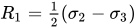
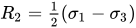
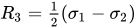
which are the equations of the three Mohr's circles for stress , , and , with radii , , and , and their centres with coordinates , , , respectively.


![\left[{\tfrac {1}{2}}(\sigma _{2}+\sigma _{3}),0\right]](https://wikimedia.org/api/rest_v1/media/math/render/svg/d32d3b2fb09d202625baa0df42fc08db094ce4c5)
![\left[{\tfrac {1}{2}}(\sigma _{1}+\sigma _{3}),0\right]](https://wikimedia.org/api/rest_v1/media/math/render/svg/be6108f95fb1e9bf64d2e770f8e220e91505d59b)
![\left[{\tfrac {1}{2}}(\sigma _{1}+\sigma _{2}),0\right]](https://wikimedia.org/api/rest_v1/media/math/render/svg/04758ef4c7e5169326291b5857f30c6ae9f83dee)
These equations for the Mohr circles prove that all admissible stress points lie on these circles or inside the shaded expanse enclosed by them (see Effigy 10). Stress points satisfying the equation for circle lie on, or outside circumvolve . Stress points satisfying the equation for circle lie on, or inside circle . And finally, stress points satisfying the equation for circle prevarication on, or exterior circle .
See also [edit]
- Disquisitional aeroplane analysis
References [edit]
- ^ "Principal stress and principal plane". www.engineeringapps.net . Retrieved 2019-12-25 .
- ^ Parry, Richard Hawley Gray (2004). Mohr circles, stress paths and geotechnics (2 ed.). Taylor & Francis. pp. ane–30. ISBN0-415-27297-ane.
- ^ Gere, James K. (2013). Mechanics of Materials. Goodno, Barry J. (8th ed.). Stamford, CT: Cengage Learning. ISBN9781111577735.
Bibliography [edit]
- Beer, Ferdinand Pierre; Elwood Russell Johnston; John T. DeWolf (1992). Mechanics of Materials . McGraw-Hill Professional person. ISBN0-07-112939-one.
- Brady, B.H.G.; E.T. Brown (1993). Stone Mechanics For Underground Mining (Third ed.). Kluwer Academic Publisher. pp. 17–29. ISBN0-412-47550-2.
- Davis, R. O.; Selvadurai. A. P. Southward. (1996). Elasticity and geomechanics. Cambridge University Printing. pp. sixteen–26. ISBN0-521-49827-nine.
- Holtz, Robert D.; Kovacs, William D. (1981). An introduction to geotechnical engineering. Prentice-Hall ceremonious engineering and engineering mechanics serial. Prentice-Hall. ISBN0-13-484394-0.
- Jaeger, John Conrad; Cook, N.K.Westward.; Zimmerman, R.Westward. (2007). Fundamentals of rock mechanics (4th ed.). Wiley-Blackwell. pp. 9–41. ISBN978-0-632-05759-seven.
- Jumikis, Alfreds R. (1969). Theoretical soil mechanics: with practical applications to soil mechanics and foundation engineering science. Van Nostrand Reinhold Co. ISBN0-442-04199-3.
- Parry, Richard Hawley Grey (2004). Mohr circles, stress paths and geotechnics (2 ed.). Taylor & Francis. pp. 1–30. ISBN0-415-27297-1.
- Timoshenko, Stephen P.; James Norman Goodier (1970). Theory of Elasticity (Third ed.). McGraw-Hill International Editions. ISBN0-07-085805-5.
- Timoshenko, Stephen P. (1983). History of strength of materials: with a brief business relationship of the history of theory of elasticity and theory of structures. Dover Books on Physics. Dover Publications. ISBN0-486-61187-half dozen.
External links [edit]
- Mohr's Circle and more circles by Rebecca Brannon
- DoITPoMS Instruction and Learning Packet- "Stress Analysis and Mohr's Circle"
heatherlyshaus1978.blogspot.com
Source: https://en.wikipedia.org/wiki/Mohr%27s_circle
0 Response to "Draw Mohrs Circle for This State of Stress"
Post a Comment